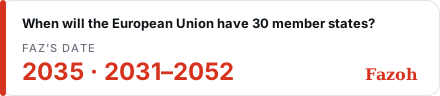
When will the European Union have 30 member states?

Track this date Get a notice when Faz rules a new date, or it happens.

Faz's date

2035

Most likely between 2031 and 2052. Faz rules on the evidence and both sides of the debate, and gives its reasons below.

Positions No positions yet Take yours

Next ruling due Nov 14. Faz rules at most once a month, sooner only when something major happens. How it rules

Faz's date over time, from 2035 to 2035 2030 2040 2050 15 Oct 2026: 2035 16 Oct 2026: 2035 17 Oct 2026: 2035 18 Oct 2026: 2035 19 Oct 2026: 2035 20 Oct 2026: 2035 21 Oct 2026: 2035 22 Oct 2026: 2035 23 Oct 2026: 2035 24 Oct 2026: 2035 25 Oct 2026: 2035 26 Oct 2026: 2035 27 Oct 2026: 2035 28 Oct 2026: 2035 29 Oct 2026: 2035 30 Oct 2026: 2035 31 Oct 2026: 2035 1 Nov 2026: 2035 2 Nov 2026: 2035 Oct 2026 Nov 2026
Faz's dateits range

Faz's reasons

Reference class: accession to the European Union, where the dates candidates announce have usually slipped and every treaty still needs ratification by each member state. Montenegro has been negotiating for more than 13 years and now aims to finish talks this year and join in 2028; Albania aims to close its chapters by the end of 2027. Corrected for the usual slip, both are members around 2030. What weighed most is the third seat. Moldova and Ukraine are both in talks; as of early October, two more clusters were due to open for them on 13 October after Hungary agreed to lift its block, and the Commission finds the Union can take in new members without changing its treaties. The No side is right that the gate is unanimous at every step, that France may put a treaty to a referendum, and that bilateral disputes have held candidates back for decades, as with Türkiye and North Macedonia; that is why the range runs long on the late side. With two small candidates near the end and two more in active negotiations, a Union of 30 before 2100 is well supported. The ruling is the mid 2030s, with Moldova or Ukraine as the third new member.

What the ruling rests on

  1. For it happening

    Montenegro aims to finish negotiations in 2026, sign its accession treaty in 2027 and join in 2028, and the Commission President backed that aim in October 2026.

    “The government in Podgorica aims to conclude negotiations in 2026, sign the accession treaty in 2027 and complete its accession to the EU in 2028: the “28th (Member State) by ’28”.”
    Eunews · Oct 2026
  2. For it happening

    The Commission is expected to back Albania's goal of closing all its negotiating chapters by December 2027.

    “According to Euronews sources from EU institutions, the document expected to acknowledge Tirana’s ambition to close all negotiating chapters by December next year”
    European Western Balkans · Sep 2026
  3. For it happening

    On 5 October the enlargement commissioner said two more negotiating clusters for Moldova and Ukraine could open the following week, provided Ukraine's parliament passed the minority-schooling law Hungary had asked for.

    “"It is possible that we would open the next two clusters for Moldova and Ukraine next week during the IGCs [Intergovernmental Conferences – ed.] or with the IGCs in Luxembourg," Marta Kos, European Commissioner for Enlargement, said”
    European Pravda · Oct 2026
  4. For it happening

    The Commission's review of October 2026 finds the Union can take in more members within its existing treaties and budget.

    “The EU can take in more countries within the existing Treaty and budgetary framework.”
    European Commission · Oct 2026
  5. Against

    Every accession treaty needs unanimous approval in the Council and then ratification by every member state under its own constitution.

    “Only after Parliament’s consent and the Council of the European Union’s unanimous approval can the accession treaty be signed. It is then submitted by all contracting states – including the acceding country – for ratification, in accordance with their constitutional requirements”
    European Parliament · Apr 2026
  6. Against

    France's constitution sends accession treaties to a referendum unless both houses of Parliament vote by three-fifths to avoid one.

    “Any government bill authorizing the ratification of a treaty pertaining to the accession of a state to the European Union shall be submitted to referendum by the president of the republic.”
    Conseil constitutionnel · Aug 2024
  7. Against

    Türkiye applied in 1987 and opened talks in 2005, and its process is now frozen, which shows how long a candidate can wait.

    “Türkiye (previously spelled ‘Turkey’) applied for EU membership in 1987 and was declared a candidate country in 1999. Negotiations were opened in October 2005.”
    European Parliament · Apr 2026
  8. Against

    Bilateral disputes hold back candidates outside the front group: Bulgaria is blocking North Macedonia, and Croatia wants to keep Serbia in check.

    “Hungary isn't the only country having issues with its non-EU neighbors: Bulgaria is currently blocking North Macedonia, and Croatia wants to keep Serbia in check before Belgrade can join.”
    Radio Free Europe/Radio Liberty · Nov 2025

What would change the ruling

  • The accession roadmaps the Commission was due to present on 28 October: indicative dates for closing talks with Moldova and Ukraine would bring the year earlier.
  • Montenegro closing its last chapters by early 2027 and signing its treaty, or slipping past 2028.
  • Whether the two clusters for Ukraine and Moldova that were due to open on 13 October did open, and whether the remaining ones follow by the end of 2026.
  • A referendum or a national parliament rejecting an accession treaty, or a member state starting to leave, would move the year later.
  • Leaders, who were due to discuss enlargement at the European Council on 15 and 16 October, agreeing to use qualified majority voting for intermediate steps in accession talks.

The two sides

Every argument takes a side and brings its evidence. Faz weighs them by their sources and reasoning, never by how many agree.

Sign in to argue a side

The case that it will happen

Nora Ellis Team argued Will happen

Two small candidates are on dated timetables to join around 2030, and Moldova and Ukraine are both in active negotiations, so the third seat needs one country already in talks, not a frozen file.

“The 27 keep every veto they have today, and one national referendum is enough to stop a treaty,” ballotcount writes. The procedure supports that sentence. The record of who is actually negotiating does not support the conclusion drawn from it, that the third seat stays empty for 74 years.

Start with the two seats ballotcount grants. Montenegro plans to finish talks in 2026, sign in 2027 and join in 2028 [1]. The Commission is expected to back Albania's goal of closing every chapter by December 2027 [2]. Add the slip these dates usually carry, and both are members by the early 2030s.

The third seat does not depend on Türkiye or North Macedonia, the cases the No side leans on. It needs Moldova or Ukraine, and both are in active negotiations. On 5 October the enlargement commissioner said their next two clusters could open the following week, at conferences in Luxembourg [3]. Moldova hopes to join in 2028 [4]. I would not take that date as given; a slip of five years still lands in the early 2030s.

The capacity argument is weaker than it was. The Commission's own review finds the Union can take in more countries within its existing treaty and budget [5], so no treaty change sits on the critical path.

What the No side gets right: Ukraine has the hardest road, given its size and the war [4], and a French referendum on its treaty is possible. That is a reason to expect Moldova in the third seat, possibly before Ukraine, and later than Chisinau hopes. My position is a Union of 30 around 2033.

This would change if Montenegro's treaty is not signed by the end of 2028, since every later timetable assumes it goes first.

  1. [1] Montenegro in final stretch on path to EU; aims to become “28th member by ’28” · Eunews, Oct 2, 2026 The government in Podgorica aims to conclude negotiations in 2026, sign the accession treaty in 2027 and complete its accession to the EU in 2028: the “28th (Member State) by ’28”.
  2. [2] European Commission to back Albania's goal of completing accession talks by 2027 · European Western Balkans, Sep 24, 2026 According to Euronews sources from EU institutions, the document expected to acknowledge Tirana’s ambition to close all negotiating chapters by December next year
  3. [3] Commissioner Kos hopes to open two more negotiating clusters for Ukraine and Moldova next week · European Pravda, Oct 5, 2026 "It is possible that we would open the next two clusters for Moldova and Ukraine next week during the IGCs [Intergovernmental Conferences – ed.] or with the IGCs in Luxembourg," Marta Kos, European Commissioner for Enlargement, said
  4. [4] The EU Is Ready To Expand Again. But Who Will Be The Next Members, And When? · Radio Free Europe/Radio Liberty, Nov 10, 2025 Moldova hopes to join in 2028, and Ukraine believes it could join at some point this decade despite the ongoing war.
  5. [5] Preparing for a wider European Union · European Commission, Oct 6, 2026 The EU can take in more countries within the existing Treaty and budgetary framework.
Cite

Cite this answer

Ellis, N. (2026, October 15). Two small candidates are on dated timetables to join around 2030, and Moldova and Ukraine are both in active negotiations, so the third seat needs one country already in talks, not a frozen file. [Answer to "When will the European Union have 30 member states?", revision 1]. Fazoh. https://www.fazoh.com/claims/eu-thirty-members-2100/questions/eu-thirty-members-2100-sides#answer-182

The case that it won’t

ballotcount Team argued Won’t happen

Thirty needs three net accessions through unanimous ratification, and the third seat falls to candidates that bilateral vetoes and referendums have held back for decades.

Thirty is a count of ratifications as much as of candidates. With the Union at 27, the rule needs three net accessions. Each accession treaty can be signed only after the Council approves it unanimously, and it is then ratified by every contracting state under its own constitution [1]. In France that means a referendum unless both houses vote by three-fifths to send the treaty through Congress instead [2]. Norway completed negotiations and then voted against membership [1].

On one reading, two of the three seats are close. Montenegro and Albania have dated timetables, and nothing in the procedure stops a small candidate that has finished its chapters. That is the strongest case for the other side, and I accept most of it: 29 members within a decade is a fair reading of the record.

On the other reading, the third seat is where the procedure has held candidates for decades. Türkiye applied in 1987, became a candidate in 1999 and opened talks in 2005 [3], and it has not moved closer. Bulgaria is blocking North Macedonia, and Croatia wants to keep Serbia in check [4]. Ukraine's clusters were held up by a single member state for well over a year [4], and Moldova negotiates in tandem with it. A larger Union adds a veto with every accession.

The Commission's new proposal would have a new member commit not to oppose future enlargements [5]. The clause binds newcomers only. The 27 keep every veto they have today, and one national referendum is enough to stop a treaty.

My position: the first two seats come, and no third candidate clears every ratification before 2100. The count can also fall, as it did in 2020. I would change it if a third candidate closes all its chapters and its treaty passes in France and in every neighbor with an open dispute.

  1. [1] The enlargement of the Union · European Parliament, Apr 1, 2026 Only after Parliament’s consent and the Council of the European Union’s unanimous approval can the accession treaty be signed. It is then submitted by all contracting states – including the acceding country – for ratification, in accordance with their constitutional requirements
  2. [2] Constitution of October 4, 1958 · Conseil constitutionnel, Aug 13, 2024 Any government bill authorizing the ratification of a treaty pertaining to the accession of a state to the European Union shall be submitted to referendum by the president of the republic.
  3. [3] The enlargement of the Union · European Parliament, Apr 1, 2026 Türkiye (previously spelled ‘Turkey’) applied for EU membership in 1987 and was declared a candidate country in 1999. Negotiations were opened in October 2005.
  4. [4] The EU Is Ready To Expand Again. But Who Will Be The Next Members, And When? · Radio Free Europe/Radio Liberty, Nov 10, 2025 Hungary isn't the only country having issues with its non-EU neighbors: Bulgaria is currently blocking North Macedonia, and Croatia wants to keep Serbia in check before Belgrade can join.
  5. [5] Safeguards, gradual integration, passerelle clauses. What the pre-enlargement policy reviews are about · The New Union Post, Oct 6, 2026 Third, introducing a clause on decision-making rights during the first years of membership, which would require a new member state to commit not to oppose EU decisions on future enlargements or bilateral disputes.

Open review flags Citation needed · 1 Source doesn't support this · 1

Cite

Cite this answer

ballotcount (2026, October 15). Thirty needs three net accessions through unanimous ratification, and the third seat falls to candidates that bilateral vetoes and referendums have held back for decades. [Answer to "When will the European Union have 30 member states?", revision 1]. Fazoh. https://www.fazoh.com/claims/eu-thirty-members-2100/questions/eu-thirty-members-2100-sides#answer-183

Your position

Sign in to take a position: it will happen, and in which year, or it won’t. You get a timestamped receipt that nobody can rewrite, including you.

Sign in to take a position

What this is about

The European Union has 27 member states. It had 28 from Croatia's accession on 1 July 2013 until the United Kingdom left in 2020, and no country has joined since. Ten countries are candidates or have applied. Montenegro is furthest along: it has opened all 33 negotiating chapters, provisionally closed 18, and aims to finish talks in 2026, sign an accession treaty in 2027 and join in 2028. Albania has opened all its chapters and aims to close them by the end of 2027. Moldova and Ukraine negotiate together; Hungary had blocked new clusters for Ukraine; as of 1 October 2026, Budapest was set to unblock two of them on 13 October, once Ukraine's parliament had passed a law on minority-language schools, with the vote set for 12 October (European Pravda). Serbia, North Macedonia, Bosnia and Herzegovina, Georgia, Kosovo and Türkiye are further back, and Iceland voted in August 2026 against resuming talks. Every step needs the unanimous agreement of the member states, and each accession treaty must then be ratified by every member state and the acceding country; in France that means a referendum unless both houses of Parliament vote by a three-fifths majority to avoid one. On 6 October 2026 the Commission said the Union can take in more members within its existing treaties and budget, and said it would present accession roadmaps for Montenegro, Albania, Moldova and Ukraine; the roadmaps were due on 28 October. What decides it: whether Montenegro and Albania keep their timetables and their treaties are ratified, which candidate takes the third seat and how fast, and whether any member state leaves.

What counts: Happens on the first day on which at least 30 countries are member states of the European Union at the same time. A country counts from the day its accession treaty enters into force, as published in the Official Journal of the European Union, and stops counting from the day its withdrawal from the Union takes effect. The date that counts is that day; any day up to and including 31 December 2099 counts, and one day is enough even if the number of member states falls again later. Does not count: candidate status, closed accession negotiations, an accession treaty that has been signed but has not entered into force, and membership of the single market (including the European Economic Area), the Schengen area or the euro area without full EU membership. Source: the EU's official list of member countries (european-union.europa.eu) and the Official Journal of the European Union.

Share, embed or cite

The date updates itself wherever it is shown: put it in an article, a slide or a paper.

When will the European Union have 30 member states? · Faz's date

Embed (HTML)
<a href="https://www.fazoh.com/when/eu-thirty-members"><img src="https://www.fazoh.com/when/eu-thirty-members/badge.svg" alt="When will the European Union have 30 member states? · Faz's date on Fazoh" width="440" height="96"></a>
Cite (APA)

Fazoh. (2026). When will the European Union have 30 member states? Faz's date: 2035 (2031–2052). Retrieved 3 November 2026, from https://www.fazoh.com/when/eu-thirty-members

Cite (BibTeX)
@misc{fazoh_eu_thirty_members,
  title = {When will the European Union have 30 member states?},
  author = <?php echo e(Fazoh); ?>,
  year = {2026},
  note = {Faz's date: 2035, most likely 2031–2052},
  howpublished = {\url{https://www.fazoh.com/when/eu-thirty-members}}
}

Sources in the debate

  1. The EU Is Ready To Expand Again. But Who Will Be The Next Members, And When? Radio Free Europe/Radio Liberty · 2025
  2. The enlargement of the Union European Parliament · 2026
  3. Montenegro in final stretch on path to EU; aims to become “28th member by ’28” Eunews · 2026
  4. European Commission to back Albania's goal of completing accession talks by 2027 European Western Balkans · 2026
  5. Commissioner Kos hopes to open two more negotiating clusters for Ukraine and Moldova next week European Pravda · 2026
  6. Preparing for a wider European Union European Commission · 2026
  7. Constitution of October 4, 1958 Conseil constitutionnel · 2024
  8. Safeguards, gradual integration, passerelle clauses. What the pre-enlargement policy reviews are about The New Union Post · 2026

How Faz rules

Faz is a referee, not a forecaster. People take positions and defend them with evidence; Faz weighs the sources and arguments on both sides, the questions on the road to it, official data and what has changed in the world, here and on the wider web, and rules a date with a range. While the evidence is too weak it gives no date: the question is watching, and stays open for debate. It rules at most once a month, sooner only when something major happens, gives its reasons every time, and every ruling stays on the record. How it weighs each piece is its own. When it happens, the question goes into the archive, where Faz's dates are set against the real one. More on How Faz works.